Headteacher – Mrs N. Bitsakaki: head@poultonstchadsce.lancs.sch.uk
Bursar – Mrs Duhig: bursar@poultonstchadsce.lancs.sch.uk
Office Tel: 01253 883639
Out of School Club Tel: 01253 372093

Welcome To

Geography

  • Our curriculum has been developed by staff to ensure full coverage of the National Curriculum.
  • We want children at Poulton St Chad’s to have no limits to what their ambitions are and grow up wanting to be ecologists, cartographers, town planners, conservationists, surveyors or weather forecasters.
  • We want to ensure that through Geography, pupils are able to explore the relationship between the Earth and its people through the study of place, space and environment. Pupils will also learn the skills of understanding locational knowledge; how and where people fit into its overall structure.
  • We want to foster children’s concern for our environment and active care of the environment. We wish to provide a platform for exploring and understanding the world in which we live and how it has evolved and is continuing to evolve over time.
  • We want the children to be immersed in key geographical vocabulary, particularly in relation to human and physical geography.
  • We also wish children to have high quality, stimulating, engaging and challenging learning opportunities both inside and outside of the classroom through experiences in practical and fieldwork activities.
  • To provide a teaching programme that builds upon experience, skills and concepts as children progress throughout the school. This programme also encourages children to develop and use a range of geographical skills.
  • We intend to provide all children regardless of ethnic origin, gender, class, aptitude or disability with a broad and balanced geography curriculum.
  • To ensure high standards of teaching and learning in Geography, we implement a curriculum that is progressive throughout the school. This curriculum gives full coverage of The 2014 National Curriculum programmes of study for Geography and in the Early Years Foundation Stage.
  • At the start of each topic teachers take time to find out what our children already understand and want to find out. Our teachers use this to adapt and extend the curriculum to match children’s interests and needs, current events, the use of any support staff and the resources available.
  • We will attempt to immerse children in Geographical vocabulary through modelling of appropriate vocabulary from staff verbally, in books and in displays.
  • Children will be stimulated, engaged and challenged through quality classroom-based teaching. To compliment this, we will also make purposeful use of outdoor education and extra-curricular activities, through use of the extensive school grounds and local area for fieldwork, visitors into school, themed days and school trips.
  • Our Geography curriculum is designed so that children start with ‘themselves’ and their local area, particularly in KS2, before working out to the UK and exploring the rest of the world.
  • Cross-curricular links are planned for, with other subjects such as Maths, Writing and Computing
  • Teachers use highly effective Assessment for Learning at different points in each lesson to ensure misconceptions are highlighted and addressed. Effective modelling by teachers ensures that children are able to achieve their learning intention, with misconceptions addressed within it.
  • The subject leader will carry out regular reviews of the subject through a range of mediums (observations, scrutinies, learning walks, staff audits, child questionnaires) to gain an understanding of what children are learning and staff confidence within the subject.
  • Children will be assessed against the age-related expectations for Geography and evidence for this will be recorded on assessment grids.
  • Most children will achieve age related expectations in Geography at the end of their cohort year, as evidenced on the assessment grids.
  • Children will retain knowledge that is pertinent to Geography and develop a general sense of enquiry, encouraging them to question and make suggestions.
  • Children use their natural curiosity to develop a geographical awareness of their immediate surroundings but also about the wider world.
  • Children will leave Poulton St Chad’s with knowledge about the values of our society and how they can protect our environment and world for years to come.
  • Children will enjoy Geography and be keen to talk about their learning. They will also be keen to showcase in their learning through displays around school.
  • Staff will have the required support needed from the Geography leader and have regular discussions about resources, CPD and assessment to ensure they have the skills and resources needed to provide children with the best possible education.

At St. Chads, we provide a high-quality geography education that inspires and engages pupils which leads them to be curious about the world and it’s people. Geography is a life skill and with excellent provision from our teachers, we hope that the skills taught in our lessons, will remain with our children for the rest of their lives. Teaching at St. Chad’s provides pupils with knowledge about diverse places, people, resources and natural and human environments, together with a deep understanding of the Earth’s key physical and human processes. As our pupils progress, their growing knowledge about the world will help them to deepen their understanding of the interaction between physical and human processes, and of the formation and use of landscapes and environments. Geographical knowledge, understanding and skills provide the frameworks and approaches that explain how the Earth’s features at different scales are shaped, interconnected and change over time.

Latest Newsletters


View Our

Geography Fieldwork Week

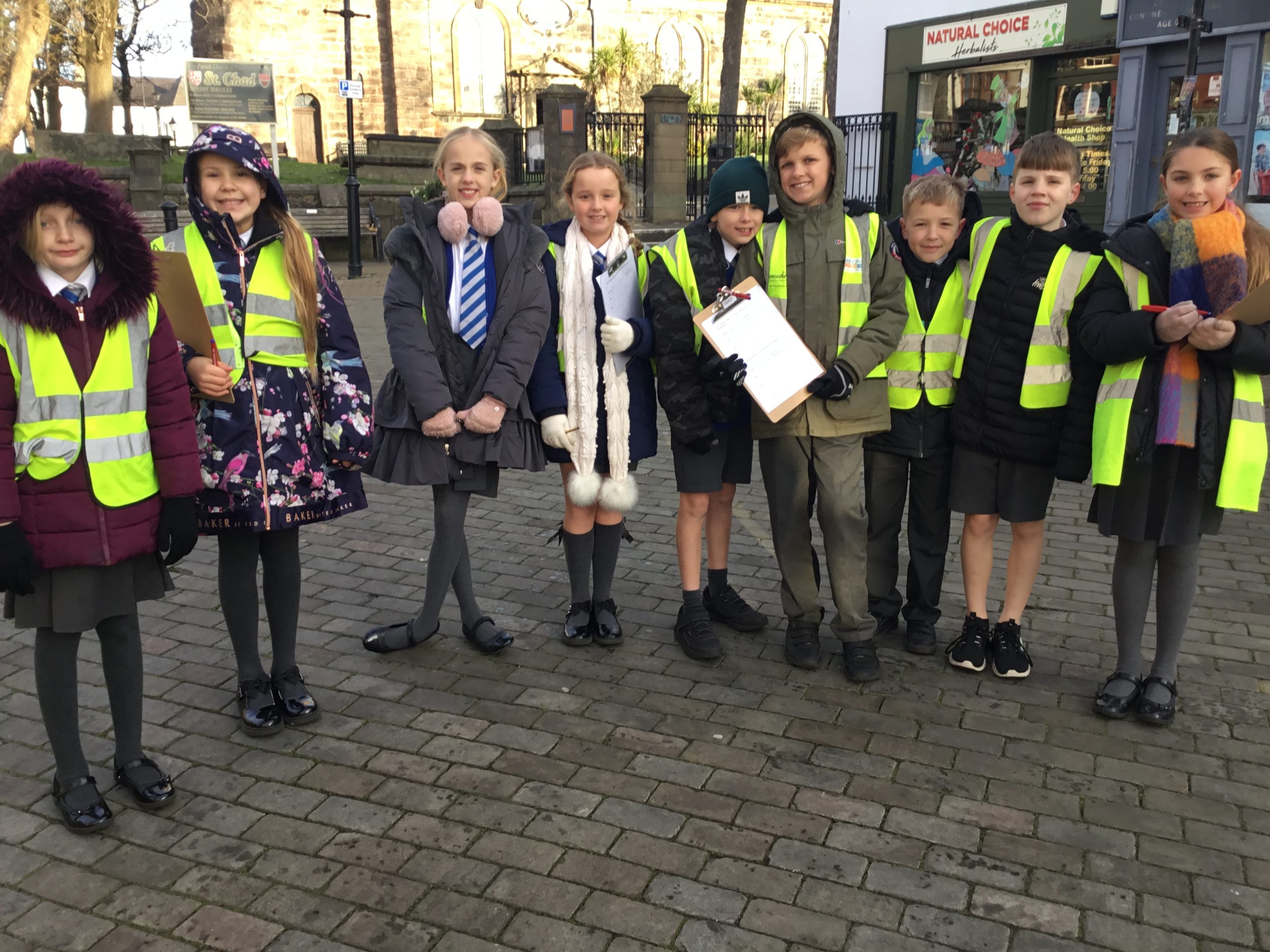
We carried out a whole school Geography Field Work (and Orienteering) in our local community of Poulton. Th activities carried out during this week varied from class to class but ranged from carrying out surveys, questionnaires, plotting and carrying out journeys as well as plotting the land use. Each class ensured that they were working towards key field work objectives appropriate to their year group. An orienteering activity was also created – creating cross curricular links to PE – which each class carried out, where the children had to carry out orienteering within the school grounds, searching for well-known local landmarks. Our Sustainability lead also had input into this week and an additional focus was placed onto climate change and the COP conference that was being held at that time.